
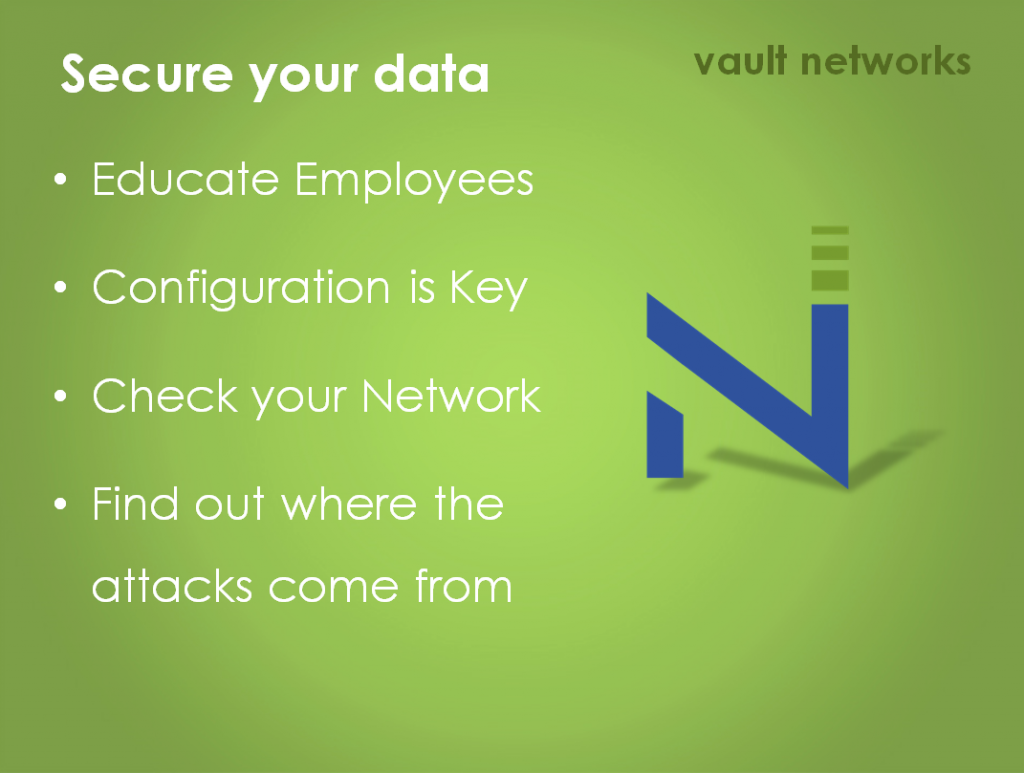
There are many ways to secure a business: lock the doors, hire a security guard, and so on. In today’s world, though, it matters just as much, if not more, to protect the 1s and 0s that make up your customer records, contracts, and private information. Losing that data can range from a serious inconvenience to a company-ending event, with plenty of bad outcomes in between. That is why it pays to secure company data by following best practices like these 4 steps.
Educate Employees to Secure Company Data
You can have every firewall and filter in the world, but if your employees go looking for trouble, they will find it, and it will hurt your business. Malicious actors attempt phishing and social engineering attacks every single day, and these attempts are frequent and ongoing, as Verizon’s Data Breach Investigations Report tracks each year. If your employees are not careful about what they download or which emails they open, plenty can go wrong quickly.
Configuration Is Key
It is easy to assume problems only come from non-IT staff. But IT also needs to stay diligent about keeping existing infrastructure patched and updated at all times, and about making sure new software configurations are not tied to old software that has gone years without a patch. A system like that hands hackers a VIP entrance to your systems for a private data fire sale, everything must go. Whenever a new installation happens, updates should be the first thing to occur, followed by security protocols such as firewalls.
Check Your Network to Secure Company Data
Speaking of firewalls, every company should have one, along with a secured network. Companies also need to verify the corporate network is the only one, with no loose ends open to the general internet. Remote access by employees and executives should happen only through VPN when outside the company network, and every internet connection needs to route through the main network. Secondary networks that skip central IT’s rules can be almost as risky as having no security at all. The one real exception is a retail environment with a second wireless network for customers, and even then, that network should have zero access to anything on the main company network.
Find Out Where and How Attacks Happen
Research matters just as much in keeping your business safe, and your industry often determines what is critical to defend against, what is moderately important, and what barely matters at all. A legal consultant who never works directly with consumers probably does not need to worry much about POS-based attacks, since he likely does not run one, while a retail store owner who works with customers directly should stay cautious about exactly that type of attack. Understand your business and how it operates, so you know what to build into your firewall and other security tools.
There are other steps to secure company data that go beyond what we have covered here, including preventing the physical theft of a server or company laptop, and Vault Networks can support you there too. Using that theft example, we can move your servers into our data center, or help you migrate to our public or private cloud environments. We can also procure additional equipment you might need to keep your data safe, such as disaster recovery tools or a firewall. To learn more about how we can help you, reach out to us by calling (305) 735-8098 option 2.